Two of Glasgow’s greatest icons have come together in one spectacular artwork to mark the opening of the Glasgow 2026 Commonwealth Games.
The Glasgow Rose will be visible high above the River Clyde, transforming the city’s iconic Finnieston Crane with a giant contemporary interpretation of Charles Rennie Mackintosh and Margaret Macdonald Mackintosh’s celebrated roses.
Created by Glasgow artist Emer Tumilty in collaboration with internationally renowned creative studio NEWSUBSTANCE, the landmark commission brings together the city’s industrial and artistic heritage in a single, unforgettable image.
For generations, the Finnieston Crane has stood as a symbol of the engineering brilliance, shipbuilding and innovation that made Glasgow famous across the world.
The Mackintosh rose has become an equally powerful emblem of the city’s creative imagination and influence on global art and design.
Now for the first time, the two enduring symbols meet.
Suspended from one of Scotland’s most recognisable landmarks, The Glasgow Rose creates a bold new addition to Glasgow’s skyline and a striking welcome for athletes and visitors arriving for the Commonwealth Games.
Drawing inspiration from the work of the Mackintoshes, Tumilty has reimagined the iconic rose through a contemporary lens, celebrating a city that has never stopped making, creating and reinventing itself.
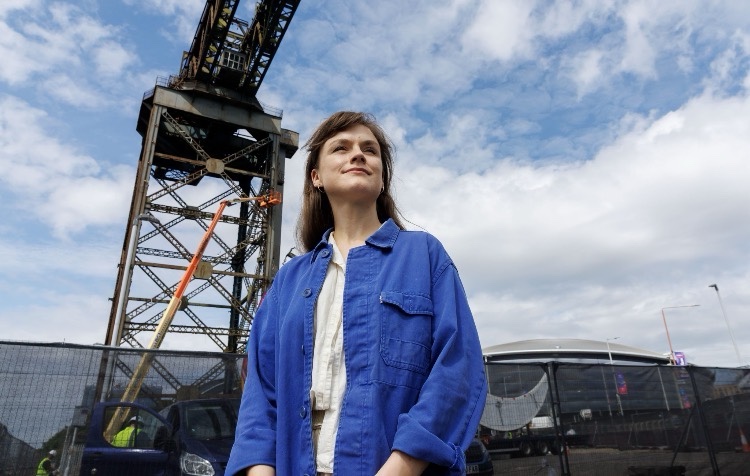
Emer Tumilty creates playful interventions in space using bold colours and abstract forms, and this commission is also a celebration of Glasgow’s creative future.
Emer Tumilty said: “As someone who came to Glasgow to study at The Glasgow School of Art before making the city my home, this has been an extraordinary commission to create.
“The Mackintosh rose is recognised around the world, and to see it reimagined at this scale, suspended from the Finnieston Crane, has been incredibly special.
“I hope people see a work that celebrates Glasgow’s creativity, optimism and character, and feel the affection for the city that inspired every part of it.”
While inspired by one of Scotland’s greatest artistic legacies, the work has been made by a new generation of Glasgow talent, reflecting the confidence and energy of the city’s thriving contemporary arts scene.
Phil Batty, Chief Executive of Glasgow 2026, said: “This is far more than a spectacular artwork. It is the coming together of two of Glasgow’s greatest icons.
“The Finnieston Crane tells the story of the city that built the world. The Mackintosh rose tells the story of the city that inspired the world.
“Together they create a powerful symbol of the Glasgow we are welcoming people to today – creative, confident, bold and proudly looking to the future.
“It feels entirely fitting that this has been created not only in honour of one of Glasgow’s greatest artistic legacies, but by one of Glasgow’s exciting new artistic voices.
“That’s exactly what these Games are about, celebrating where we’ve come from while championing the talent shaping where we’re going.”
Patrick O’Mahoney, Founder and Creative Director of NEWSUBSTANCE, added: “Projects like this only happen when art, engineering and creative ambition come together.
“The Glasgow Rose is as much an engineering achievement as it is an artistic one.
“To transform one of Glasgow’s most iconic structures into a canvas at this scale has been an extraordinary challenge and a privilege.
“The result is something that belongs uniquely to Glasgow.”
While Matthew Williams, Director of the Charles Rennie Mackintosh Society has said: “Charles Rennie Mackintosh has been at the heart of Scottish culture for over 150 years so it’s exciting to see an interpretation of his work included as part of the Commonwealth Games and to showcase the work of emerging Glasgow-based artist Emer Tumilty.”
Visible across the Clyde throughout the Commonwealth Games, The Glasgow Rose is commissioned as part of Glasgow 2026 Festival, a ten-week celebration of the city’s creativity, culture and communities running alongside the Games.
To find out more about the Glasgow 2026 Festival, visit the website here

