The MP for Carlisle Julie Minns, is delighted at the news that plans to recognise the RAF’s unsung heroes of the Photographic Reconnaissance Units have progressed to the planning stage.
Announced by Veterans Minister, Al Carns MP this marks the culmination of a campaign with broad political support, with more than 200 MPs from eight parties uniting to back the call for a Photographic Reconnaissance Units memorial.
Among the strongest supporters was Ms Minns, who in January 2025 urged the Leader of the House to ensure the unit was included in Parliament’s commemorations marking the 80th anniversary of the Second World War.

Julie Minns, MP for Carlisle and North Cumbria said: “I am delighted to see my support for the campaign to commemorate those who served in the Photographic Reconnaissance Unit has helped to bring this memorial one step closer.
“Due to the clandestine nature of their operations – flying solo operations, unarmed and unarmoured – the Photographic Reconnaissance Units death rate was nearly fifty percent.
“As a result, these brave men and women had one of the lowest survival rates of the war, around two and a half months.
“Four Carlisle men served under these exceptionally challenging conditions: Rae Armstrong, Ivan Cooke, William Johnston, and Charles Ross.
“I remain committed to supporting the Spitfire AA810 Project in establishing this memorial and look forward to paying my respects to these local men and their colleagues from all Photographic Reconnaissance Units when it is completed.”
Since 2021, the Spitfire AA810 Project has campaigned to establish a memorial to the 1746 PRU pilots and navigators.
Welcoming the announcement, Spitfire AA810 Project Director, Tony Hoskins, said: “Since we first looked at commemorating the highly clandestine work of the RAF unarmed Reconnaissance Squadrons.
“We have uncovered some incredible stories of the work these young men and women carried out, their actions unknown yet so vital to millions of people impacted by the conflict.
“The work of the RAF PRU enabled Allied leaders to monitor almost every aspect of the enemy’s activity and act accordingly.
“They became a vital component of every Allied campaign – with the intelligence gained considered necessary for the planning of any operation.
“It is a fitting tribute to see this work commemorated in the very heart of London, so close to where that intelligence was used so critically.”
The intended location for the memorial would be outside the Treasury, close to the entrance of the Imperial War Museum’s Churchill War Rooms, facing St James’ Park.
The location has received approval in principle from the Royal Parks and Department for Culture, Media and Sport to proceed to the next stage, which includes ground surveys, design, and planning.
The monument currently stands to commemorate 2,370 individuals from over twenty nationalities.
It is also intended that the memorial will recognise the Photographic Interpreters, who were based at RAF Medmenham, in Buckinghamshire.
While research continues into the 443 remaining airman’s nationalities, four men from Carlisle are known to be among them.
Anyone with any information can visit the Spitfire AA810 Project here to help with their research.
Rae Armstrong
Flight Lieutenant Rae Daly Armstrong DFC was born and lived in Carlisle, but little is currently known of his life other than he served in 16 Photographic Reconnaissance Squadron and he was awarded the Distinguished Flying Cross (DFC) for his work in early 1945.
He survived the war but little else is known of his life, and the Spitfire AA810 Project is appealing for anyone who knew him to get in touch.
Charles Ross
Flight Sergeant Charles B Ross was from Carlisle. Little is known of his prewar life, other than he served in 681 Photographic Reconnaissance Squadron in the Far East.
It is not known if he survived the war. Like Rae Armstrong, the Spitfire AA810 Project is appealing for any information on him to help tell his story.
Ivan Cooke
Flying Officer Ivan Ernest Cooke was born at Howden in 1909 to John and Elizabeth Cooke. He was educated at Wallsend Secondary School, and Leeds Training College before becoming assistant schoolmaster at Stephenson Memorial School in Willington Quay. In 1934 he met and married Phyllis Fox and the couple moved to Carlisle where he took up a similar school appointment.
At the outbreak of war, he joined the Home Guard in Carlisle but in 1941 decided to join the RAF and train as a navigator. He was posted to 69 Photographic Reconnaissance Squadron based on Malta, where he carried out operations over Italy and North Africa. On the 2nd September 1943 whilst flying from RAF Luqa, his Baltimore aircraft collided with a Spitfire operating from the same airfield. Both aircraft crashed to the ground outside of the airfield perimeter, and everyone on both aircraft were killed.
Ivan Cooke is buried in the Capuccini Cemetery, Malta.
William Johnston
Flying Officer William Lewis Johnston was born in Carlisle in 1922, the son of Thomas and Margaret Johnston. He met Agnes and they married, residing in Carlisle. Joining the RAF, Johnston trained as a pilot and after converting to fly Spitfires he was posted to 16 Photographic Reconnaissance Squadron.
On the 30th December 1944 he was returning to what is now Brussels airport from a photographic sortie over Germany when his aircraft was seen to crash on approach to land and burst into flames.
22-year-old William Johnston was killed. He is buried in Brussels Town Cemetery.
Photographic Reconnaissance Units
The Photographic Reconnaissance Units was formed on September 24, 1939 and throughout the Second World War it operated highly dangerous, clandestine photographic reconnaissance operations over all theatres of operation, and captured more than 26 million images of enemy operations and installations during the war.
The purpose of the Unit was to provide up-to-date intelligence to strategically plan the Allied actions in the war.
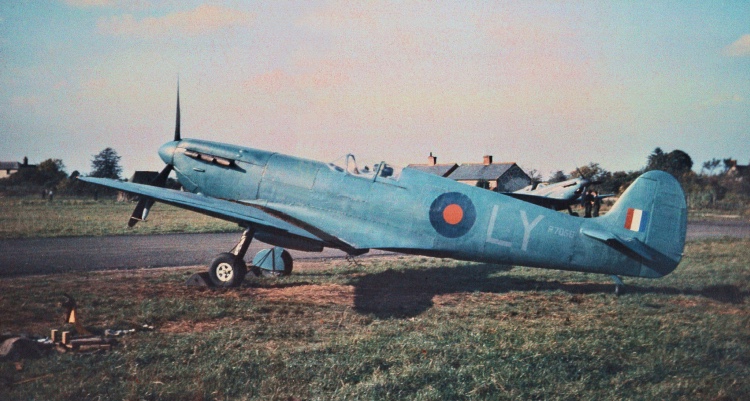
Flying Spitfires and Mosquitos, the intelligence it gathered was used by all the armed forces, giving same day intelligence on enemy activity.
The intelligence provided by the PRU was used in the Cabinet War Rooms – now the ‘Churchill War Rooms’ located underneath the Treasury – and was instrumental in the planning of major operations.
This included but is not limited to D-Day and the Dambusters Raid; the monitoring of major shipping movements such as the Bismarck and Tirpitz; and locating the site of the V1 and V2 rocket launching site at Peenemünde.
Photographic Interpreters
The Photographic Interpreters, who were based at RAF Medmenham, in Buckinghamshire used stereoscopy, to analysed the photographs for the intelligence service.
The 635 Photographic Interpreters – a third of whom were women, included the likes of post-war actor, Dirk Bogarde, and Sarah Churchill, the wartime Prime Minister’s daughter.
Their role was crucially important to the entire operation, as without their skill and analysis, the 26 million photographs would not have produced the war winning intelligence that it did, ensuring that the pilots sacrifice was not in vain.
 THE HERDWICK NEWS