Cumbria’s five MPs were split with three voting against at the Assisted Dying Bill after an emotional debate.
The Terminally Ill Adults (End of Life) Bill or Assisted Dying Bill was brought forward by Labour’s Kim Leadbeater and received 330 votes in support compared to 275 against.
The bill was given a rare free vote meaning MPs could vote however they wanted with no repercussions from their party.
After an emotional debate where Conservative Andrew Mitchell said he had changed his mind after finding himself with “tears pouring down my face” at hearing the stories from constituents while fellow MP Danny Kruger said the public deserve better than a “state suicide service.”

How Your MP Voted
- Josh MacAlister, Whitehaven and Workington – Supported
- Markus Campbell-Savours, Penrith and Solway – Supported
- Julie Minns, Carlisle – Against
- Michelle Scrogham, Barrow and Furness – Against
- Tom Farron, Westmorland and Lonsdale – Against
Only two of Cumbria’s MPs voted in support of the bill with the other three voting against it.
Liberal Democrat’s Tim Farron, Westmorland and Lonsdale MP, spoke in the debate before voting against the bill said during the debate: “Neither side has a monopoly on compassion, I will always be affected by watching my mum suffer at her death at the age I am now, so let us not think badly of one another’s motives; let us instead be courteous and let us be curious.
“My opposition to the Bill is grounded in compassion. To legalise assisted dying would be to create the space for coercion that would undoubtedly see people die who would not otherwise have chosen to do so. There are no safeguards in the Bill that would prevent that.”
Carlisle MP Julie Minns had already said that she was not supporting the bill for three reasons, “the reservations expressed by many disabled people and disability organisations.
“To vote in favour is, in effect, a vote to fund one – and only one – form of death. Everyone should have the right to a good death. This Bill only deals with one.
“There is nothing definitive about a six-month terminal prognosis, yet the Bill will require this – nor do I believe there can be watertight safeguards against coercion.”

Whitehaven and Workington MP Josh MacAlister voted in support of the bill later said: “I’d like to thank everyone who contacted me about this issue in advance of the vote.
“I received some very emotional testimonies from those who were forced to watch friends and family members suffer needlessly at the end of their lives, even when they had excellent palliative care. It was those people I thought of when I walked through the ‘Aye’ lobby to vote in favour of the Bill.
“Fundamentally for me it is a matter of choice and I believe those who want it should have the choice to die with dignity when they are in their final months and facing unimaginable suffering as the alternative. The Bill puts in extremely tight safeguards to guard against coercion which reassured me that we can do this in a safe and compassionate way.
“There will now be all the scrutiny that every Bill gets after second reading, which will give MPs further chances to discuss and debate it line by line, and it will be many months before it becomes law, but this was an important first step.”
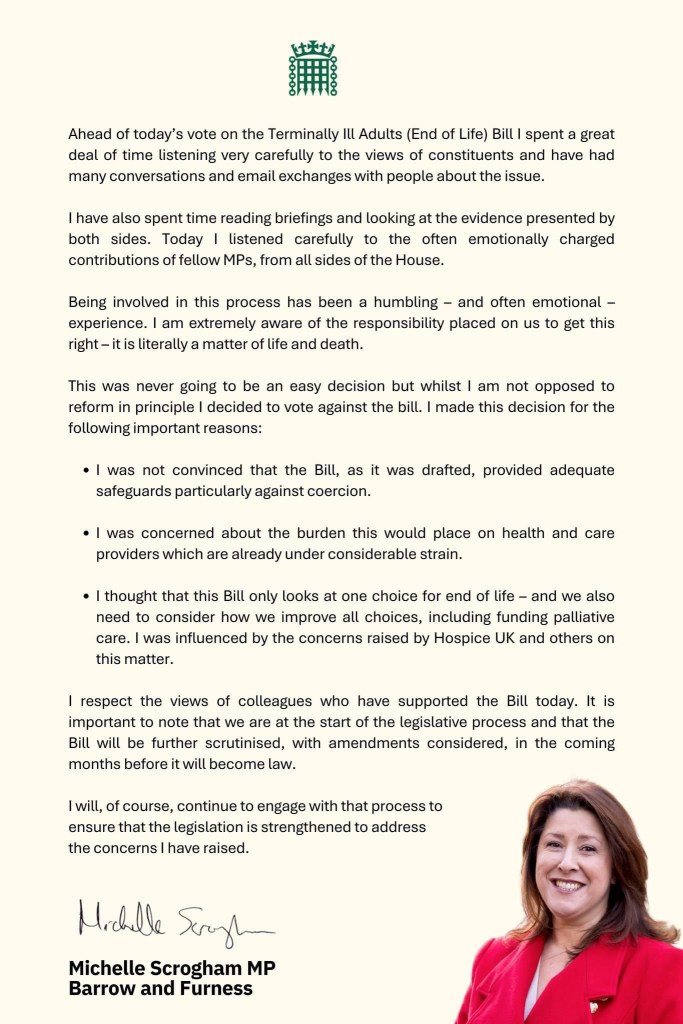
While Michelle Scrogham, Barrow and Furness MP, released this statement saying that her reason for not supporting the bill despite being “not opposed the reform in principle.”
The MP wrote: “I was not convinced that the Bill, as it was drafted, provided adequate safeguards particularly against coercion.
“I was concerned about the burden this would place on health and care providers which are already under considerable strain.
“I thought that this Bill only looks at one choice for end of life – and we also need to consider how we improve all choices, including funding palliative care. I was influenced by the concerns raised by Hospice UK and others on this matter.”
What Happens Now
Now the Private Members Bill, Terminally Ill Adults (End of Life) Bill, has passed its second reading in the House of Commons it will head to the Committee Stage where it will face more scrutiny.
The Committee Stage could be either a selection of MPs or as it is a contentious Bill the whole House of Commons.
After that it heads to the Report Stage where a debate is held in the House with the Speaker selecting amendments to be voted on.
It will then have a third reading before going to the House of Lords where they can add amendments, if they do it then comes back to the House of Commons.
If the House of Commons agrees with the amendments made by the House of Lords it would then receive royal assent and become law.
The whole process could take between six and eighteen months.
 THE HERDWICK NEWS